
What If Data Centers Actually Benefited Communities?

Updated: Jun 11
'The Maybe Try Giving A Shit Theory' of Data Centers

Fuck data centers, am I right?
Actually, not exactly. Welcome to my theory of how to properly implement data centers. It’s called The Maybe Try Giving A Shit Theory: a data center should only be allowed if they can self-sustain AND give back to the community.
I don’t mean creating jobs either. Data centers do not create meaningful numbers of permanent jobs to offset community resource burden.
As with every thing these days, there is no room for gray anymore. As we watch the greediest folks on the planet try to convince the public that data centers are necessary we realize it doesn’t matter because they can just buy politicians. Looking at you, Big Gretch. Singling her out for specifically advocating for what a community majority voted down aka the opposite of doing her job.
AI is not at all artificial. It is man made. It is not at a solution on its own but it is a tool. AI as a term has been around for 70 years, it’s only recently that the “AI” branding stuck. In my industry, we’ve been using software to render and draw for decades. Drawings and images all created artificially. Yes, we’re all way over the use of it to crank out the most basic-ass art, music, and writing. It sucks when it’s used as a vending machine doling out what it considers culture. But the tool is only as good as the person using it. A paint brush in my hand is useless vs a paint brush in Monet’s hands. But AI in the hands of an eye specialist with access to thousands of prior eye scans might now be able to compare and diagnose a rare condition whereas before it would be physically impossible to compare a patient’s scans to such a high volume of possibilities. And at the end of the day, you still need that eye specialist behind the curtain to review results and test the accuracy of the AI results.
For my industry, I have found 2 worthwhile uses for AI that don’t involve drawing or image creation. If you’ve ever tucked into a building code book, you know where the word “awful” came from. Insanely high density of information, odd terminology, and pretty it’s terribly organized. A quick question to Chatgpt and it directs me to the precise section of code dealing with the scenario I’ve laid out. Of course I have to check the validity of where it tells me to look but it’s a HUGE time savings and has about a 90% accuracy rate.
Anyone with a small business knows that legal stuff comes up. For me, it's people who don't pay. In the olden times, I would have had to hire an attorney to navigate the collections process, which often made pursuing smaller amounts pointless. Instead, I used AI to walk me through the lien process, filed a lien against a contractor, and successfully recovered $6,000 with $0 in legal fees.
AI Isn’t Evil. Extractive Infrastructure Is.
The problem isn't AI. The problem is when enormous infrastructure projects extract resources from communities without returning meaningful value. Anyone who was around when the internet went from wobbly fawn to spring legged deer may remember that there was talk of charging for the privilege of it’s use. If you don’t remember, there were discussions of charging per click, per website visit, etc. Yes, we still pay for the utilities we need to utilize the internet, but for all intents and purposes, the world wide web is free. You can go to a public library and access it. But then good luck getting a New York Times recipe without a pay wall. So, yeah, I get it. “Free” definitely has big fat Chris Farley exaggeratedly pantomimed quotation marks.
But somehow the burden to power and cool AI data centers falls on locals who are supposed to absorb increased electrical rates and just hope there’s enough water to cool all this magical data.
The Real Problem: Resource Burden Without Public Benefit
Technology exists to make data centers basically self-sustaining. It’s called waste-to-energy. They’ve been around since the 1970’s and have only gotten more and more efficient. There are currently operational facilities in Austria, Sweden, Ireland, Turkey, Singapore, Japan, Switzerland, Poland, and Denmark. In a nutshell, garbage is collected and incinerated in facilities that use the incineration process to create heat & electricity for the surrounding areas.
Data centers themselves are not new. What’s new is the scale. The truth is, data centers have been around since the 40s. The earliest facilities were designed purely to support the massive hardware, cooling, and heavy cabling of early computers. Same as now. So, I’m not arguing against them existing, but the way these new super data centers just steamroll local municipalities and override community opposition.
The Maybe Try Giving A Shit Theory
So back to The Maybe Try Giving A Shit Theory. A data center should always be a waste-to-energy facility that in order to exist must:
build adjacent affordable housing
provide low-cost heat to the surrounding homes & businesses
collect enough garbage from surrounding homes & businesses to not drain the existing electrical infrastructure
be built in a way that it is not a tear down pole barn when the data center is no longer needed.
I don’t have a billion-dollar R&D budget, but the math is revealing. And let me just tell you that running the numbers shows just how staggering the volume of resources used by today’s data centers is.
My model for waste-to-energy data is Copenhill in Copenhagen, Denmark. I’m using it because it’s a stellar example of a utility giving back to the community in more ways than just heat & electricity. Copenhill is also a ski hill and walking trail, open year round. And I can attest to this as we visited it in March; no snow but there was a snowboarder there. Other people were there as well. There’s a nice little bar/café and roof deck area. And no, there was no burning trash smell permeating the area (that "smoke" is pure water vapor). You could get a small smell of trash on the top of it near a certain exhaust vent but nothing repellent. Here’s some pics of it: I love the classic factory architecture vibe with a modern twist and the contrast of the base with the rooftop

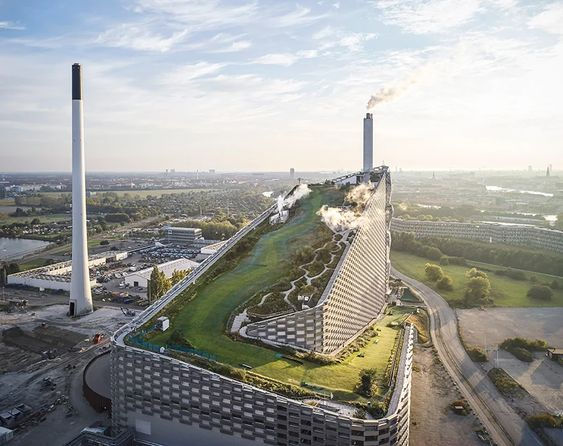

For the data center data, I’m using the above mentioned voted-down-by-the-community-but-being-built-anyways Saline data center, which just happens to be in my back yard.
This is what is being built:
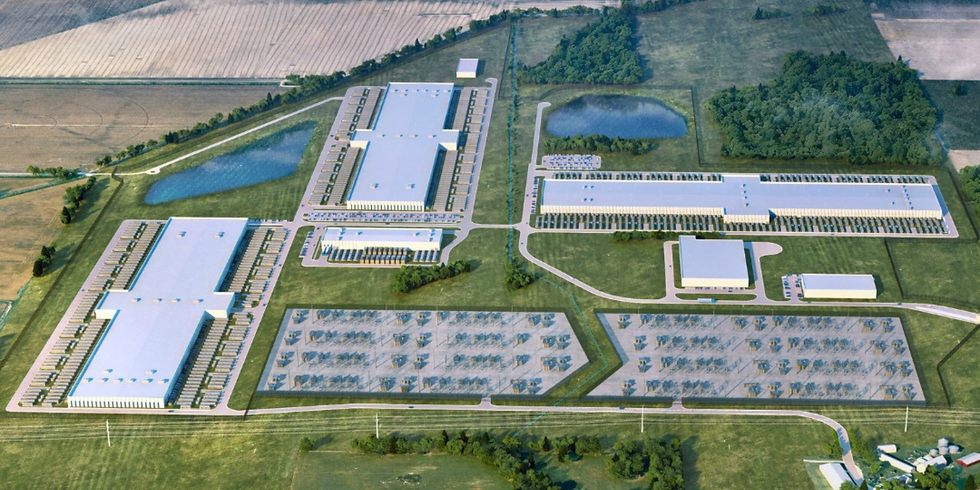
Now, this is just me who doesn’t identify as part of the master greed class, but the math checks out. I don’t have the budget for R & D but They do.
The problem can be the solution.
And They could still monetize it.
First, let's look at the scale of the problem
The Numbers Are Staggering
With a waste-to-energy model:
It would take approximately 22 CopenHill-scale facilities to generate the same electrical output as the Saline data center consumes. (To be clear, I'm not proposing that twenty-two CopenHills be built across Michigan. I'm using CopenHill as a model for how infrastructure can provide public value through heat recovery, waste utilization, and civic integration.)
To support the Saline data center electrically using the same model would therefore require waste streams from roughly:
6.6 million households
1.5 million businesses
That statistic alone illustrates the enormous scale of energy required by hyperscale AI infrastructure.

Yellow area = the approximate portion of Michigan that would need to supply waste under a CopenHill-scale model
The Hidden Opportunity: Waste Heat
Nearly all electricity consumed by a data center ultimately becomes heat. In other words, a data center is essentially a giant thermal plant that happens to process information.
Heat rejection.
That is the real bottleneck.
If a data center can:
export heat into district heating,
affordable housing,
greenhouses,
industrial users,
thermal storage systems,
then:
water demand drops,
cooling infrastructure shrinks,
evaporative losses decrease,
and overall efficiency improves dramatically.
A 1.4 GW data center therefore produces approximately:
1.4 GW of continuous waste heat
or roughly 12,264 GWh of heat annually
For comparison:
CopenHill’s district heating system delivers approximately 1,300 GWh of heat annually
enough to heat roughly 87,000 apartments
That means the Saline data center could theoretically generate:
Nearly 9.4 times more recoverable heat than CopenHill currently supplies to Copenhagen’s district heating system.
Using the same proportional relationship:
87,000 apartments × 9.4 ≈ 818,000 apartments
So, in theory,
the Saline data center could produce enough recoverable heat to support: Approximately 800,000+ apartments or housing units
if designed from the outset with district heating infrastructure.
So instead of a vast industrial complex, for this rural area it should be something like this:

The more traditional brick style "factory" is a better fit for rural areas. The other bonus of putting any kind of thought into a data center building is that when/if the data center is done, the building can be re-used as a library, museum, farmers market, school, etc.
Closer to urban areas, a contemporary version works too.
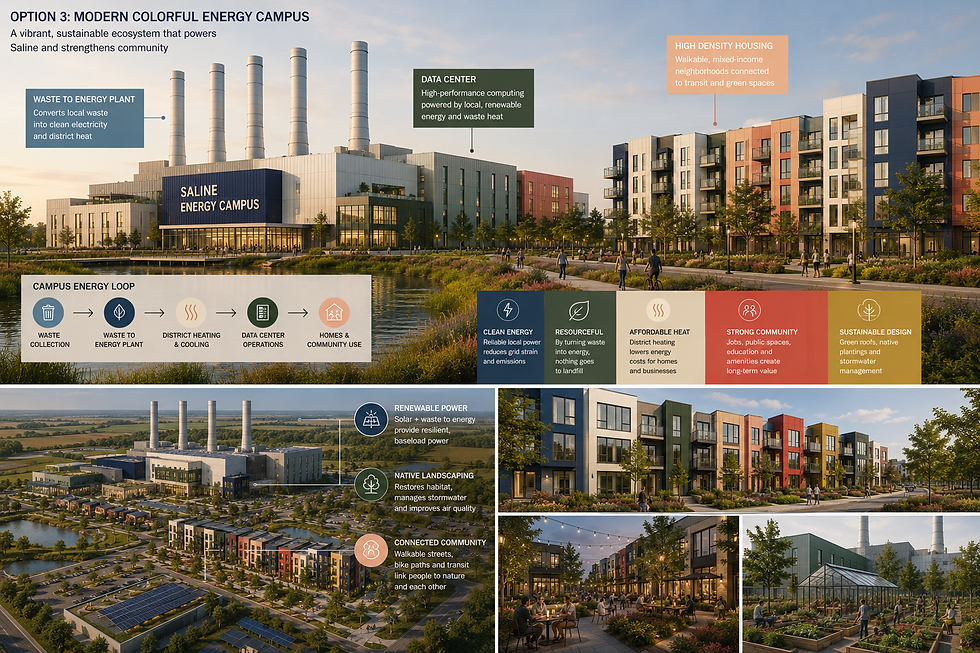
Yes, these are AI generated images created and refined by me. See? Useful. You get the idea and I didn't have to spend months trying to illustrate my concepts. Even if you strip away the intense greenery added to the images- it's 1000x better than this:
A Data Center as Civic Infrastructure
Today, most American data centers are designed as isolated industrial utilities:
massive electrical demand,
enormous cooling loads,
little direct public benefit.
The CopenHill model suggests a different approach-
Instead of treating waste heat as a liability, it becomes:
affordable housing heat,
greenhouse heat,
municipal building heat,
snowmelt systems,
industrial process heat,
district energy infrastructure.
At the same time, colocated waste-to-energy systems could:
reduce landfill use,
create local baseload generation,
offset portions of grid demand,
improve grid resilience,
and create a clearer public benefit for host communities.
The Most Important Insight
The real innovation of CopenHill is not the incinerator.
It is the idea that:
Large infrastructure projects should provide visible, measurable civic value to the communities that host them.
Applied to hyperscale AI infrastructure, that could mean:
mandatory heat recovery,
required affordable housing districts,
district energy systems,
public amenities,
and integrated waste-to-energy generation.
In other words:
The future data center should not be a sealed industrial box. It should function as part of the public energy ecosystem of the city around it. The question isn't whether communities should accept data centers. The question is what communities should receive in return.
The Other End of the Spectrum
One final thought.
The scale of infrastructure required to implement this idea is enormous. Not insurmountable, but enormous.
A couple years ago I wrote about a concept I called the Future Furnace. Instead of scaling waste-to-energy up to the size of a city or data center, it scales the idea down to the individual household or business. The basic premise is simple: use your own waste stream to generate the electricity and heat needed to power your building.
If enough homes and businesses adopted a system like that, we likely wouldn't spend much time worrying about the electrical demand of data centers because the grid itself would look fundamentally different.
The challenge would then become what to do with all the excess heat. Personally, I think that's where affordable housing, large-scale greenhouse agriculture, and district energy systems become interesting. Instead of treating heat as a waste product, we could use it to lower housing costs, extend growing seasons, support local food production, and reduce overall energy demand. Housing, food production, and energy generation could all become part of the same ecosystem.
Whether the answer is giant district-scale systems like CopenHill or decentralized systems like Future Furnace, the underlying idea is the same:
Waste is only waste if we fail to use it.
You can read more about the Future Furnace concept here.


Comments